Understanding Radon and Radon Inspection
Did you know that high levels of radon, a naturally occurring gas that we breathe every day, is the 2nd  leading cause of lung cancer?
Were you aware that it is easy to find out if the radon rate in your home is dangerous?
Did you know that it is easy to fix elevated radon levels in your home?
For years, real estate professionals have consistently advised homebuyers to test for radon before finalizing a purchase—and for good reason. Radon is a naturally occurring, odorless gas that can seep into homes through cracks in floors or walls, construction joints, or gaps around utility pipes. Over time, exposure to elevated radon levels can pose a serious health threat, as it is the second leading cause of lung cancer in the United States.
What is Radon or A Radon Inspection Exactly?
Fortunately, testing for radon is straightforward and, if necessary, mitigation is relatively affordable. To better understand the risks, Dr. Oz offers a helpful video explaining how radon enters the home and its potential impact on health. If you’re unfamiliar with radon or its dangers, the video serves as a great introduction. You can watch it here: Dr. Oz Video on Radon. After viewing, if you’re interested in professional testing, Mitchco Home Inspection Services is available to help.
When it comes to cost, professional radon testing typically runs under $200 and provides quick, reliable results. If high levels are detected, installing a mitigation system usually costs between $800 and $1,000—an investment worth making to protect your health. Alternatively, DIY test kits are available at a lower cost. However, these kits are not recommended for real estate transactions due to their vulnerability to tampering and reduced accuracy.
Additionally, Missouri residents can request one free DIY radon test kit per household by calling 866-628-9891. These kits include a prepaid return mailer and are easy to use. However, be aware that results may take up to a month and are generally not accepted in real estate deals due to limited precision and processing time.
Ultimately, we share this information out of genuine concern for your health and well-being. In Missouri, about 1 in 5 homes exceed the EPA’s radon safety threshold of 4.0 picocuries per liter. Homes that are energy-efficient or lack proper ventilation may face even greater risk. Radon may be invisible, but with proper awareness and action, it’s entirely manageable.
Radon Levels in the St. Louis area
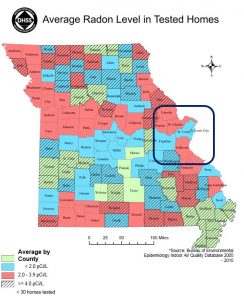
Missouri is identified by the EPA as having moderate risk. This means that there is good chance that any given home will have radon levels in their home that is higher than 4.0 pCi/L, the level established by the EPA as putting your health at risk.
| St. Louis Home Radon Levels | |||
| Average Radon Level (pCi/L) |
% of Homes above 4.0 pCi/L |
% of Homes above 2.0 pCi/L |
|
| Missouri Counties: | |||
| St. Louis City | 2.5 | 17.8% | 48.2% |
| St. Louis County | 4.0 | 28.8% | 56.6% |
| St. Charles County | 4.0 | 27.5% | 54.5% |
| Jefferson County | 5.3 | 37.0% | 67.3% |
| Franklin County | 3.4 | 32.8% | 60.2% |
| Warren County | 4.1 | 35.1% | 61.4% |
| Lincoln County | 4.0 | 33.0% | 60.8% |
What does this mean?
If you live in St. Louis County, almost 1 in 3 homes has radon levels that are above the level the E.P.A. defines as safe.
Your risk of living in a home with high radon levels is lowest in St. Louis City, and highest in Jefferson County, MO.
Does this mean that St. Louis City homeowners don’t need to test their homes?
Absolutely not.
While your chances of having a home with a radon issue is lower, if you happen to live in the 1 in 5 home that DOES have a dangerous radon level, you are putting yourself and your family at risk for lung cancer even if you do not smoke. If you are a smoker or former smoker, your risk for getting lung cancer is even higher.
People who live in rental homes or ground level condos should also have their homes tested.